
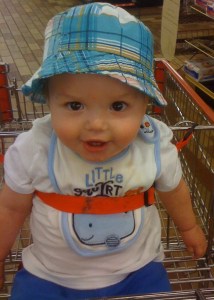
By June of 2010 we were seven months into our nightmare known as epilepsy. Our baby boy continued to seize and continued to miss milestones. It was depressing and heartbreaking. We were desperate to make them stop.
About eight weeks or so out from Owen’s first birthday, we went to see a new neurologist at our local children’s hospital that came highly recommended by a co-worker of mine. It wasn’t that we didn’t think our current neurologist was doing a good job. We just felt that Owen’s case had become too complex and we needed to kick things up a notch.
When we saw the doctor, she mentioned that epilepsy surgery might be Owen’s best hope for achieving seizure freedom and having a more normal life. By this time, we had read much about different types of epilepsy surgeries, so this didn’t scare us. Crazy as it may sound, we were excited to discuss surgical options. One, if successful, it could mean the end of his seizures for good. Two, it could also mean he wouldn’t have to spend the rest of his life on anti-seizure medications. The first of these two would be a dream come true. The second, would be the icing on the cake.
She mentioned that children who have Infantile Spasms and fail to get the seizures under control could progress to a severe form of epilepsy called Lennox Gastaut syndrome. Now epilepsy surgery can mean just removing a brain lesion, to removing part of a lobe of the brain, to a whole lobe, or even an entire hemisphere of the brain. It all depends on the seizure focus. Of course, we were hoping that as little of Owen’s brain as possible would need to be removed for him to be seizure free. Unfortunately, the doctor speculated that Owen was going to need a hemispherectomy in order or his seizures to go away. Go big or go home, I guess. And, that option would only be available if his seizures were isolated to one hemisphere of his brain. If the seizures proved to be starting in both hemispheres, well, then it was game over. Surgery would not be an option.
When the doctor mentioned the word hemispherectomy, she paused, as I think she thought we’d lose it. We didn’t, however. Quite the contrary. We would have had we not already been well versed on the topic, but since we spent most of our free time on the internet reading about epilepsy, we’d already become desensitized to it. Sad, but true.
Before we started on our journey with epilepsy, I wouldn’t have even thought it possible to live with half a brain, but you can. A hemispherectomy is a surgical procedure which involves total, or partial removal of an affected cerebral hemisphere or disconnecting the affected hemisphere from the unaffected one. There are two types of hemispherectomies, anatomical and functional. An anatomical hemispherectomy involves removal of more brain tissue and can cause more complications, such as blood loss and hydrocephalus. A functional hemispherectomy involves removing less of the affected hemisphere and disconnecting the rest of the brain tissue from the other hemisphere, with less chance of the aforementioned complication. Which procedure is done depends on the patient’s issue. Both result in seizure freedom in about 70% of the cases according to the Cleveland Clinic.
In order to determine if this was even an option for Owen, he’d have to have to go inpatient or long term monitoring (EEG) to see where the seizure focus was and have a PET scan. Once those were done, his case would go before a board of medical experts to determine if he was a surgical candidate.
While we certainly weren’t delighted with the prospect of having to decide to have half of our son’s brain removed, the alternative, a life of continuing, unrelenting seizures was much worse. The seizures needed to be stopped in order for Owen to have any chance at a somewhat normal life. Given that, we needed for him to be a surgical candidate. The thought of us being told otherwise was simply unthinkable.
![Owen's 1ST Birthday party[1]](https://idonthavetimeforthissh.com/wp-content/uploads/2019/05/owens-1st-birthday-party1-e1558993977414.jpg?w=178&h=300)
 I Don't Have Time for This Sh*#!